
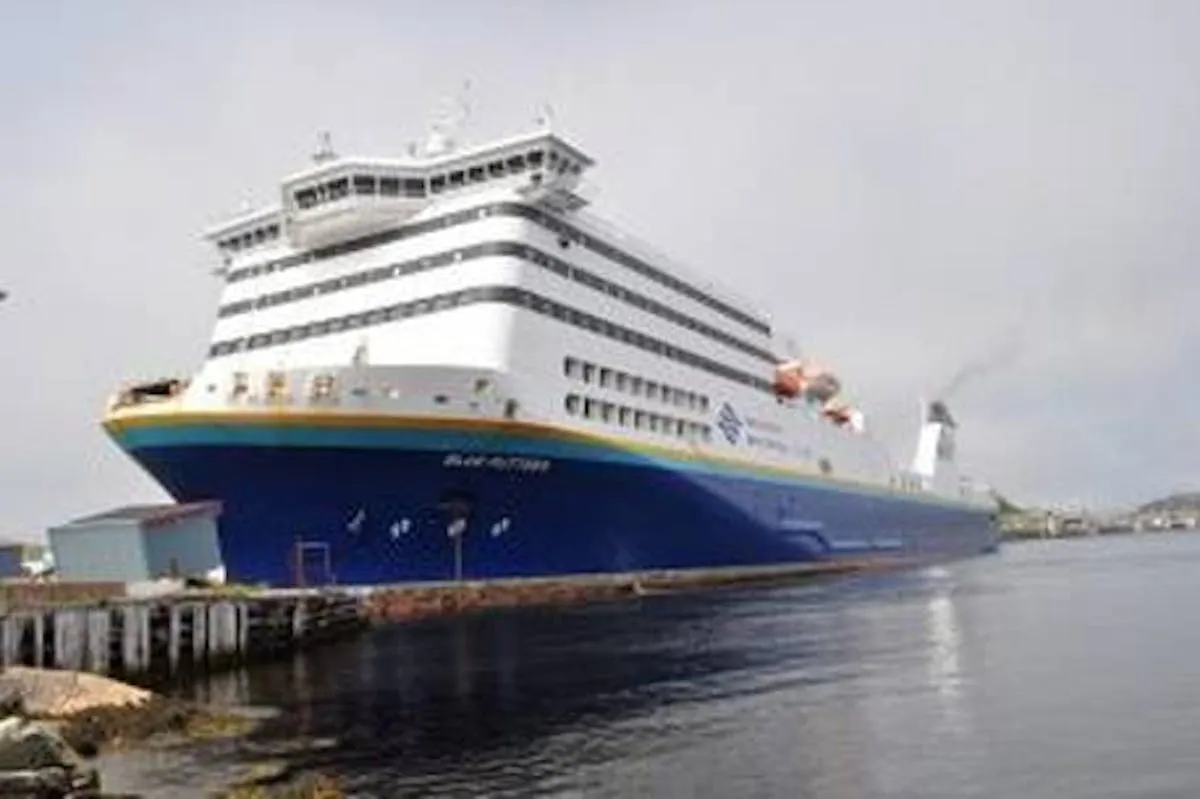
Port ordered. Starboard applied.
31 July 2013 · Port aux Basques, Canada
A helm order has been given. Does the actual rudder position match the instruction?
This review examines that verification gap using Marine Atlantic’s update of 12 September 2013, which presents findings attributed to the Transportation Safety Board of Canada (TSB).
1 | Incident snapshot
| Vessel | Blue Puttees, passenger ferry |
| Operation | Leaving the berth at Port aux Basques |
| People aboard | 398 passengers; 91 crew |
| Damage | Damage around the bulbous bow; No. 1 ballast tank punctured |
| Injuries and pollution | Neither was reported |
2 | Document sequence
| Stage | Reported action | Result |
|---|---|---|
| Leaving the berth | The master called for 10° to port and set ahead pitch to 50%. | The quartermaster instead put the rudder 10° to starboard. |
| About 42 seconds later | A starboard change in the heading line on the radar drew the master’s attention. | The master identified the wrong-side rudder application. |
| Attempt to stop | The master selected full astern pitch. Speed had reached 9.6 knots. | The ferry grounded before it stopped. |
This sequence is based on Marine Atlantic’s published account of TSB findings, not a reconstructed bridge-audio transcript.
3 | Where Helm Order Monitor is relevant
The following is ELNAV.AI’s technical interpretation, separate from the published investigation findings.
Helm Order Monitor combines automatic speech recognition with available bridge and steering data to support the verification of spoken helm orders during manual steering. For a wrong-side execution scenario, the relevant check is the relationship between the requested rudder action and the actual response.
| Verification step | Information needed | Intended contribution | Important boundary |
|---|---|---|---|
| Recognise the order | A sufficiently clear spoken helm order | Establish the requested rudder direction and angle | Uncertain audio must not be treated as a confidently recognised instruction. |
| Check execution | Actual rudder angle, associated with the current order | Identify a response inconsistent with the instruction | Allow for normal rudder movement and verify sensor orientation and timing. |
| Prompt verification | A sufficiently reliable mismatch assessment | Draw the bridge team’s attention to the order and actual helm | The bridge team decides how to respond; the system does not take control. |
An advisory such as WRONG HELM is intended to direct attention to a command–response discrepancy. It should not be interpreted as a diagnosis of why the discrepancy occurred or as an instruction for a particular recovery manoeuvre.
4 | The safety lesson extends beyond one helm input
The operator’s update also mentions recommendations to review bridge resource management and harbour entry and departure speeds.
Our reading of the case leads to three practical priorities:
- Verify execution, not just communication. Recognising or acknowledging a helm order is not the same as checking that the rudder has been applied as intended.
- Make the discrepancy actionable. A useful advisory should help the bridge team check the instruction and response, rather than speculate about an individual’s condition or intentions.
- Keep the wider operation in view. An additional verification tool should complement bridge-team coordination and appropriate manoeuvring decisions, not justify reduced monitoring or training.
5 | Operational requirements and limits
Reliable helm-order verification depends on the configured installation and the quality of its inputs. The following considerations apply when assessing its operational use:
- Speech recognition: whether the correct order can be identified under representative bridge conditions.
- Data integrity: whether actual rudder position is correctly configured, sufficiently current and aligned with the order.
- Response assessment: whether normal steering movement can be distinguished from wrong-side or otherwise inconsistent execution.
- Alert usefulness: whether an advisory is timely, understandable and useful without creating avoidable distraction.
The reported interval before the error was recognised is not a demonstrated HOM warning window. This incident review does not establish when HOM would have alerted or whether an alert would have prevented the grounding. It is not a report of HOM deployment or measured performance aboard Blue Puttees.
Take-home message
A helm order needs confirmation of execution, not just acknowledgement.
HOM supports that check by comparing the recognised instruction with available steering data and bringing a discrepancy to the bridge team’s attention. It does not replace the team’s judgement or the procedures used to manage the manoeuvre.
Source: Marine Atlantic, Marine Atlantic provides update on MV Blue Puttees incident, 12 September 2013. This article uses the operator’s published account of TSB findings, not the original TSB correspondence.
