
Incident Analysis
Based on TSB Marine Investigation Report M16P0378. This case shows how a fatigued lone watchkeeper can miss one critical alteration and trigger pollution, sinking, and long-tail liability.
Important note: Aware Mate was not installed on Nathan E. Stewart / DBL 55. This page uses the official investigation to show where an earlier on-board vigilance alert could have helped interrupt the incident chain. Any intervention sequence is illustrative, not proof of a live deployment.
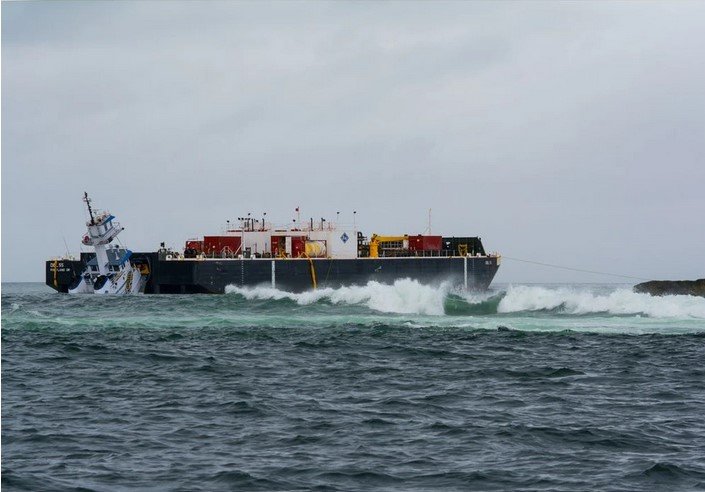
Shortly after 01:00 on 13 October 2016, the articulated tug-barge Nathan E. Stewart / DBL 55 grounded on Edge Reef near Athlone Island at the entrance to Seaforth Channel, west of Bella Bella, British Columbia. The tug’s hull was breached, about 110,000 litres of diesel were released, and the tug later sank and separated from the barge. This incident shows how one missed course change can escalate into a major environmental and commercial casualty.

The TSB found that the watchkeeper, alone on the bridge and affected by fatigue, unintentionally fell asleep and missed a critical course alteration. The articulated tug-barge then ran onto Edge Reef, breaching the tug, releasing diesel into the environment, and ultimately leading to the sinking of Nathan E. Stewart.
This casualty did not arise from one failure alone. Several protective layers were weak at the same time.
• The watchkeeper was alone on the bridge at the critical moment and unintentionally fell asleep.
• Fatigue exposure was significant and the missed course alteration was not interrupted in time.
• There was no effective second barrier between the loss of vigilance and contact with Edge Reef.
• Once grounding occurred, the consequence chain extended immediately beyond navigation error into spill response and total-loss exposure.
In a case like Nathan E. Stewart / DBL 55, the role of an additional vigilance layer is not to promise certainty. It is to create more warning time before a missed course alteration becomes reef contact, fuel release, and sinking.
The value here is earlier interruption of the chain, because the commercial and environmental tail grows very fast after impact.
Aware Mate is an on-board, human-in-the-loop vigilance layer designed to complement bridge watchkeeping and BNWAS. It estimates sustained drowsiness and distraction risk from non-identifying cues such as eyelid closure, gaze stability, head position, and posture, then issues graded local alerts. Where configured, it can use a BNWAS-compatible dry-contact path to escalate through existing shipboard alarm chains.
Aware Mate does not steer the vessel, take navigational decisions, identify people, diagnose medical conditions, perform emotion recognition, or send raw video ashore by default. Standard operation is on-board processing with configurable retention for derived metrics and event logs.
A missed course alteration on a towing unit can move from routine navigation error to spill response in minutes.
This is the full-tail casualty logic: pollution, salvage, wreck issues, and liability all sit behind one fatigue-driven bridge failure.
It is an unusually clear example of why early human-factor controls matter before the casualty rather than only after it.
Take-home message: Nathan E. Stewart / DBL 55 is a textbook case for earlier vigilance warning on top of stronger fatigue control and bridge discipline.
| Cookie | Duration | Description |
|---|---|---|
| cookielawinfo-checkbox-analytics | 11 months | This cookie is set by GDPR Cookie Consent plugin. The cookie is used to store the user consent for the cookies in the category "Analytics". |
| cookielawinfo-checkbox-functional | 11 months | The cookie is set by GDPR cookie consent to record the user consent for the cookies in the category "Functional". |
| cookielawinfo-checkbox-necessary | 11 months | This cookie is set by GDPR Cookie Consent plugin. The cookies is used to store the user consent for the cookies in the category "Necessary". |
| cookielawinfo-checkbox-others | 11 months | This cookie is set by GDPR Cookie Consent plugin. The cookie is used to store the user consent for the cookies in the category "Other. |
| cookielawinfo-checkbox-performance | 11 months | This cookie is set by GDPR Cookie Consent plugin. The cookie is used to store the user consent for the cookies in the category "Performance". |
| viewed_cookie_policy | 11 months | The cookie is set by the GDPR Cookie Consent plugin and is used to store whether or not user has consented to the use of cookies. It does not store any personal data. |
See how Aware Mate fits your bridge setup and discuss operational fit, privacy boundaries, and next steps.