
Incident Analysis
Based on the MAIB investigation. This is one of the clearest examples of how fatigue, no lookout, and an unused watch alarm can leave a vessel running unattended for hours before it grounds.
Important note: Aware Mate was not installed on Antari. This page uses the official investigation to show where an earlier on-board vigilance alert could have helped interrupt the incident chain. Any intervention sequence is illustrative, not proof of a live deployment.
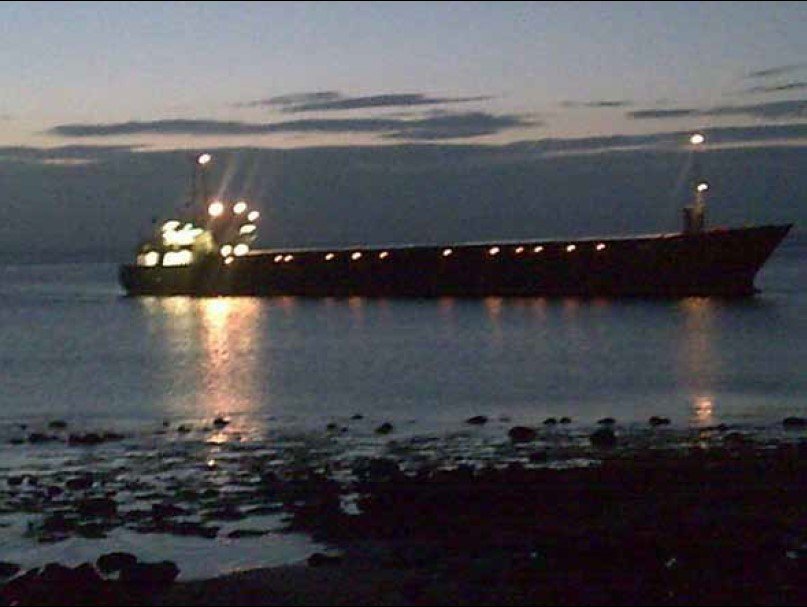
At 03:21 on 29 June 2008, the general cargo vessel Antari grounded on the coast of Northern Ireland while on passage from Corpach, Scotland, to Ghent, Belgium. There were no injuries, but the vessel sustained extensive bottom damage after running on for hours with nobody effectively watching the bridge.

The officer of the watch fell asleep shortly after taking over at midnight as the vessel passed the Kintyre peninsula. With no-one awake on the bridge, Antari continued across the North Channel for over 3 hours before grounding on a gently sloping beach about 7 miles north of Larne.
This casualty did not arise from one failure alone. Several protective layers were weak at the same time.
• The chief officer and master were working a six-on/six-off regime that posed a serious cumulative-fatigue risk.
• There was no dedicated lookout on the bridge during the night despite the requirements of STCW.
• The watch alarm was not switched on, removing a barrier that could have alerted others on board.
• Company SMS audits had failed to detect that key watchkeeping safeguards were routinely not being applied.
• This was not a sudden surprise event. The vessel had a long, unattended run before grounding.
This incident had a wide intervention window. That makes it a strong example of where an earlier on-board vigilance alert could have interrupted the chain well before contact with the coast.
The primary fixes remain proper lookout practice, safe manning, and realistic fatigue control. Aware Mate fits best here as an earlier-warning layer inside that wider safety system.
Aware Mate is an on-board, human-in-the-loop vigilance layer designed to complement bridge watchkeeping and BNWAS. It estimates sustained drowsiness and distraction risk from non-identifying cues such as eyelid closure, gaze stability, head position, and posture, then issues graded local alerts. Where configured, it can use a BNWAS-compatible dry-contact path to escalate through existing shipboard alarm chains.
Aware Mate does not steer the vessel, take navigational decisions, identify people, diagnose medical conditions, perform emotion recognition, or send raw video ashore by default. Standard operation is on-board processing with configurable retention for derived metrics and event logs.
A vessel does not need heavy traffic or bad weather to become high risk if the bridge watch is effectively unattended.
Long unattended transits increase exposure not only to hull damage, but also to coastal pollution and third-party loss.
This case shows the practical value of alerting earlier than a traditional post-failure response.
Take-home message: Antari is a textbook case for earlier vigilance signals. It also shows that alarms only matter when they are actually used and supported by bridge discipline.
| Cookie | Duration | Description |
|---|---|---|
| cookielawinfo-checkbox-analytics | 11 months | This cookie is set by GDPR Cookie Consent plugin. The cookie is used to store the user consent for the cookies in the category "Analytics". |
| cookielawinfo-checkbox-functional | 11 months | The cookie is set by GDPR cookie consent to record the user consent for the cookies in the category "Functional". |
| cookielawinfo-checkbox-necessary | 11 months | This cookie is set by GDPR Cookie Consent plugin. The cookies is used to store the user consent for the cookies in the category "Necessary". |
| cookielawinfo-checkbox-others | 11 months | This cookie is set by GDPR Cookie Consent plugin. The cookie is used to store the user consent for the cookies in the category "Other. |
| cookielawinfo-checkbox-performance | 11 months | This cookie is set by GDPR Cookie Consent plugin. The cookie is used to store the user consent for the cookies in the category "Performance". |
| viewed_cookie_policy | 11 months | The cookie is set by the GDPR Cookie Consent plugin and is used to store whether or not user has consented to the use of cookies. It does not store any personal data. |
See how Aware Mate fits your bridge setup and discuss operational fit, privacy boundaries, and next steps.