
Incident Analysis
Based on the MAIB investigation. This case links sleeping on watch with a wider management problem: alcohol control, lookout discipline, BNWAS use, and voyage-planning assurance had all broken down at the same time.
Important note: Aware Mate was not installed on BBC Marmara. This page uses the official investigation to show where an earlier on-board vigilance alert could have helped interrupt the incident chain. Any intervention sequence is illustrative, not proof of a live deployment.
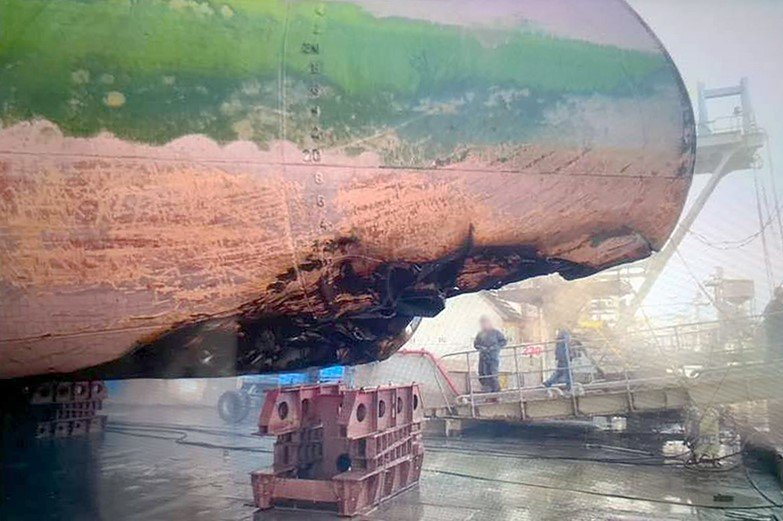
At 03:32 on 25 July 2021, the cargo vessel BBC Marmara ran aground on Eilean Trodday while transiting the Little Minch from Foynes to Scrabster. The ship was later refloated, but dive inspection found major damage at the bow, including penetration of the bow-thruster space and forepeak tanks.
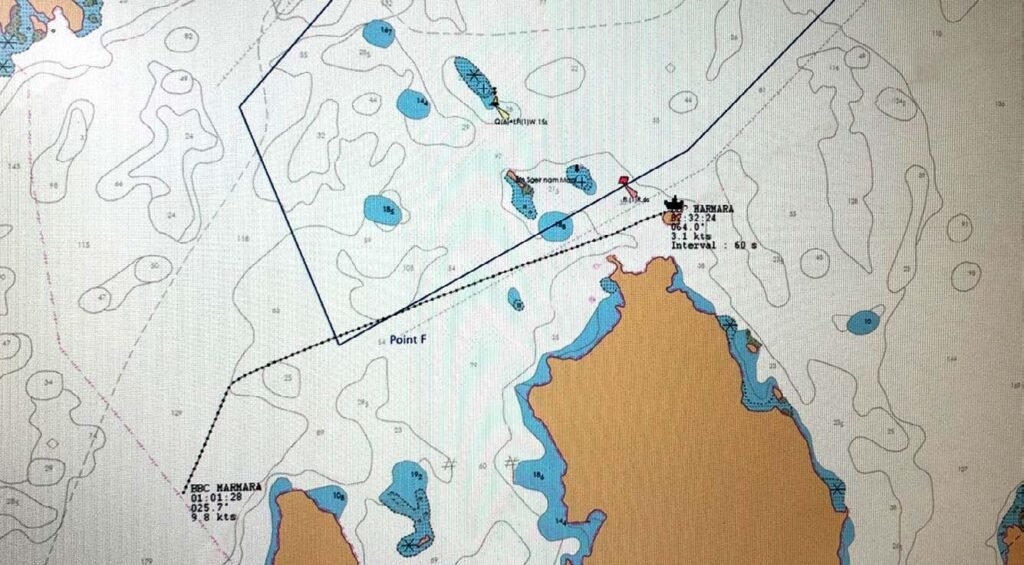
MAIB found that the officer of the watch was asleep when the vessel grounded. He was alone on the bridge because there was no lookout, the bridge watch alarm had been disabled, and he had been drinking alcohol both immediately before and at the start of his watch. The voyage plan in use also differed from the approved route package supplied for the ship.
This casualty did not arise from one failure alone. Several protective layers were weak at the same time.
• The onboard alcohol policy was not being enforced in practice.
• The required lookout was absent during darkness, even though records suggested otherwise.
• BNWAS had been disabled, removing a core safety barrier.
• Management did not have reliable assurance tools to verify whether these controls were actually followed on board.
• Stornoway MRCC did not intervene before grounding because watchkeepers were distracted by an ongoing search-and-rescue case.
Because alcohol was involved, this page should stay conservative. The credible public case for Aware Mate is earlier indication that bridge vigilance had degraded, not a claim that it would have solved every weakness present on board.
In a case like BBC Marmara, Aware Mate should be sold as one earlier-warning layer inside a broader safety system that still depends on lookout discipline, alcohol control, and management assurance.
Aware Mate is an on-board, human-in-the-loop vigilance layer designed to complement bridge watchkeeping and BNWAS. It estimates sustained drowsiness and distraction risk from non-identifying cues such as eyelid closure, gaze stability, head position, and posture, then issues graded local alerts. Where configured, it can use a BNWAS-compatible dry-contact path to escalate through existing shipboard alarm chains.
Aware Mate does not steer the vessel, take navigational decisions, identify people, diagnose medical conditions, perform emotion recognition, or send raw video ashore by default. Standard operation is on-board processing with configurable retention for derived metrics and event logs.
This case shows that bridge incidents are often management failures before they are track-control failures.
Hull damage, cargo delay, dry-dock cost, and audit questions all follow quickly when safeguards are disabled.
The value proposition is practical: earlier alerts, on board, with humans still making the decisions.
Take-home message: BBC Marmara is a strong reminder that vigilance technology only has real value when it is framed as support for disciplined watchkeeping, not as a substitute for it.
| Cookie | Duration | Description |
|---|---|---|
| cookielawinfo-checkbox-analytics | 11 months | This cookie is set by GDPR Cookie Consent plugin. The cookie is used to store the user consent for the cookies in the category "Analytics". |
| cookielawinfo-checkbox-functional | 11 months | The cookie is set by GDPR cookie consent to record the user consent for the cookies in the category "Functional". |
| cookielawinfo-checkbox-necessary | 11 months | This cookie is set by GDPR Cookie Consent plugin. The cookies is used to store the user consent for the cookies in the category "Necessary". |
| cookielawinfo-checkbox-others | 11 months | This cookie is set by GDPR Cookie Consent plugin. The cookie is used to store the user consent for the cookies in the category "Other. |
| cookielawinfo-checkbox-performance | 11 months | This cookie is set by GDPR Cookie Consent plugin. The cookie is used to store the user consent for the cookies in the category "Performance". |
| viewed_cookie_policy | 11 months | The cookie is set by the GDPR Cookie Consent plugin and is used to store whether or not user has consented to the use of cookies. It does not store any personal data. |
See how Aware Mate fits your bridge setup and discuss operational fit, privacy boundaries, and next steps.