
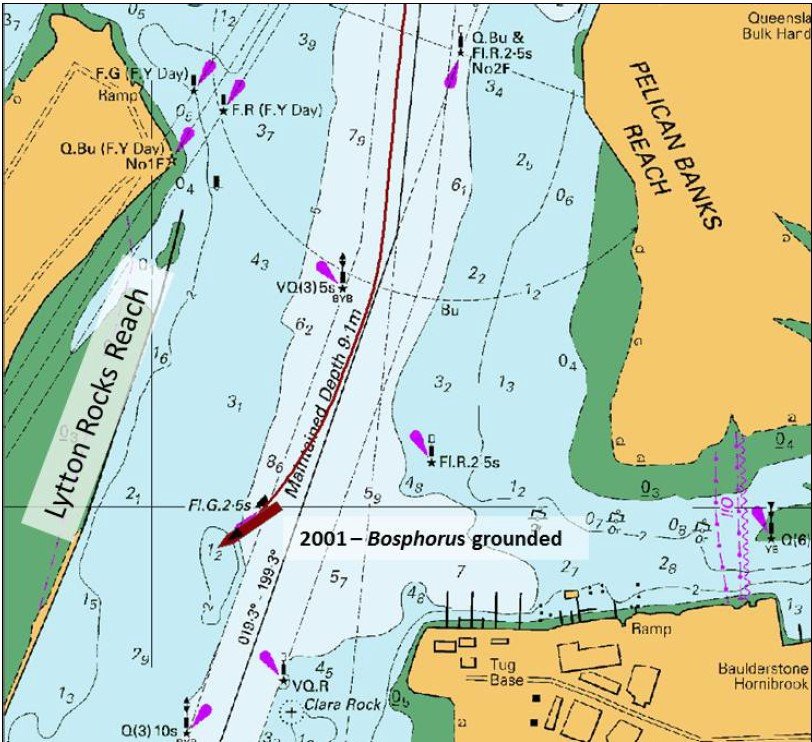
At about 20:01 on 29 October 2013, the general cargo ship Bosphorus grounded at Lytton Rocks Reach in the Brisbane River. During a starboard turn through the reach, the helmsman unintentionally applied hard‑to‑port while the pilot continued to call for starboard. The vessel touched the channel edge and grounded within seconds.
1 | Incident snapshot
| Vessel | Bosphorus, general cargo ship |
| Operation | Inbound pilotage in hand steering |
| Grounding | 20:01 local time, as recorded in the occurrence narrative |
| Recovery | Refloated with tug assistance; underway again by 20:20 |
| Injuries and pollution | None reported |
| Damage assessment | No damage identified at the berth; a later underwater inspection found hull scraping and slight propeller damage |
Source: ATSB report, The occurrence, pp. 1–4. The later inspection findings should not be replaced with an unqualified statement that there was no damage.
2 | Relevance to Helm Order Monitor
ELNAV.AI technical interpretation, separate from the investigation findings.
Helm Order Monitor compares recognised spoken helm orders with available bridge and steering data. A correct repeat-back can help establish what was understood, but does not establish what the rudder actually did.
| Verification step | Relevant check | Operational boundary |
|---|---|---|
| Recognise the current order | Identify the requested direction and angle from the spoken instruction | Uncertain recognition must not be treated as confirmed intent. |
| Compare the actual response | Assess whether configured rudder data is consistent with that instruction | Allow for normal steering movement, data timing and any subsequent order. |
| Prompt the bridge team | Draw attention to a sufficiently reliable execution mismatch | An advisory does not steer the vessel or prescribe the recovery manoeuvre. |
WRONG HELM is relevant as an advisory about inconsistent execution. Its relevance is the order–response relationship, not an inference about the helmsman’s emotional or cognitive state.
This historical review is not evidence of HOM deployment or measured performance aboard Bosphorus. It does not establish when HOM would have alerted or whether an alert would have prevented the grounding.
3 | Documented sequence
| Stage | Pilot’s instruction | Recorded execution or intervention |
|---|---|---|
| Initial turn | Starboard 5, starboard 10, then midships and steady on 199° | The ship began the intended starboard turn. |
| Continuing swing | Midships, then port 10 | The helmsman repeated port 10 but applied 10° starboard. |
| Further correction | Port 20, then hard to port | The orders were repeated, but starboard helm was applied. |
| Error recognised | The pilot challenged the wrong direction within nine seconds | The third mate moved the wheel hard to port. |
| Outcome | Astern propulsion and tug assistance were requested | The vessel grounded. |
Source: ATSB report, The occurrence, p. 3. This is a summary of the reported sequence, not a verbatim bridge transcript or a second-by-second simulation.
4 | Operational lessons
ATSB also identified ineffective helm monitoring, unclear bridge-team responsibilities and an incomplete watch handover during a critical phase. Its analysis considered attentional disengagement a likely explanation for the helmsman’s actions. These are investigation findings, not states detected by HOM. [Safety analysis, pp. 6–9; Findings, p. 10.]
Our practical reading is:
Keep handovers from interrupting verification. The team needs continuity in monitoring current orders and their execution through a change of watch.
Verify execution as well as read-back. A correctly repeated instruction should not close the check before the actual response has been assessed.
Make monitoring responsibility explicit. An additional advisory should complement, not replace, a clearly assigned bridge-team role.
Take-home message
A correct read-back does not guarantee a correct rudder response.
HOM supports the bridge team’s execution check by comparing recognised instructions with available steering data. Responsibility for the manoeuvre, verification and corrective action remains with the bridge team.
Source: Australian Transport Safety Bureau, Grounding of Bosphorus, Brisbane River, Queensland, 29 October 2013, report 304-MO-2013-011, final report released 22 September 2014. References use printed page numbers.
