
Incident Analysis
Based on TSB Marine Investigation Report M04L0092. This case shows how one missed course alteration in pilotage waters can expand into grounding, lightering, delay, and salvage complexity.
Important note: Aware Mate was not installed on Horizon. This page uses the official investigation to show where an earlier on-board vigilance alert could have helped interrupt the incident chain. Any intervention sequence is illustrative, not proof of a live deployment.
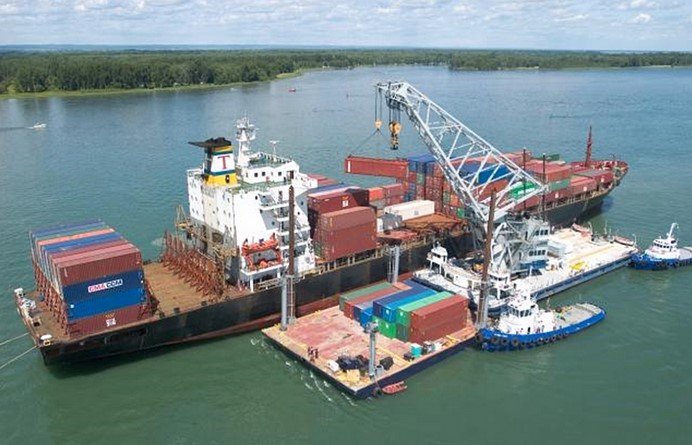
In the early morning hours of 24 July 2004, the loaded container vessel Horizon was downbound from Montreal, Quebec, under the conduct of a pilot when it overshot the alter-course position off Sainte-Anne-de-Sorel and grounded along its entire length. Initial refloating attempts failed. After 109 containers were off-loaded, the vessel was re-floated 11 days later. No pollution was observed and damage to the vessel was minor. This incident shows how a single lapse in pilotage waters can still trigger operational disruption and salvage cost.

The TSB found that the pilot, who had the conduct of the vessel, did not order a timely course alteration. Fatigue may have been a factor in the pilot’s decreased vigilance at a critical time. The officer of the watch did not effectively monitor the vessel’s progress, and effective bridge resource management techniques were not used in the minutes leading up to the grounding. Communication between bridge team members was minimal. The report also noted that without local knowledge or ECS or ECDIS, the officer of the watch had limited means to monitor the vessel’s track and intervene effectively in complex pilotage waters.
This casualty did not arise from one failure alone. Several protective layers were weak at the same time.
• The pilot, seated on the port side of the wheelhouse and having the conduct of the vessel, did not order a timely course alteration
• Fatigue may have been a factor in the pilot’s decreased vigilance at a critical time.
• The officer of the watch did not effectively monitor the vessel’s progress.
• Effective bridge resource management techniques were not used and communication between team members was minimal.
• Without local knowledge or ECS or ECDIS, the officer of the watch had limited means to monitor the track and challenge effectively in complex pilotage waters.
In a case like Horizon, the role of an additional vigilance layer is not to replace pilotage or bridge teamwork. It is to surface reduced alertness earlier and support earlier cross-checking before an overshot course alteration becomes a grounding.
The value here is earlier warning and earlier challenge. Aware Mate should be presented as a support layer inside stronger bridge resource management, not as a replacement for pilotage, procedures, or local knowledge.
Aware Mate is an on-board, human-in-the-loop vigilance layer designed to complement bridge watchkeeping and BNWAS. It estimates sustained drowsiness and distraction risk from non-identifying cues such as eyelid closure, gaze stability, head position, and posture, then issues graded local alerts. Where configured, it can use a BNWAS-compatible dry-contact path to escalate through existing shipboard alarm chains.
Aware Mate does not steer the vessel, take navigational decisions, identify people, diagnose medical conditions, perform emotion recognition, or send raw video ashore by default. Standard operation is on-board processing with configurable retention for derived metrics and event logs.
Pilotage waters still depend on effective monitoring, challenge, and shared situational awareness across the bridge team.
Even without pollution or major hull loss, a grounding can still trigger lightering, tug use, delay, salvage cost, and claims complexity.
This case shows the upstream gap between being on the bridge and actively monitoring the ship’s track in real time during a critical course alteration.
Take-home message: Horizon is a case for earlier signals, stronger bridge resource management, and better cross-checking before a routine pilotage leg becomes a grounding.
| Cookie | Duration | Description |
|---|---|---|
| cookielawinfo-checkbox-analytics | 11 months | This cookie is set by GDPR Cookie Consent plugin. The cookie is used to store the user consent for the cookies in the category "Analytics". |
| cookielawinfo-checkbox-functional | 11 months | The cookie is set by GDPR cookie consent to record the user consent for the cookies in the category "Functional". |
| cookielawinfo-checkbox-necessary | 11 months | This cookie is set by GDPR Cookie Consent plugin. The cookies is used to store the user consent for the cookies in the category "Necessary". |
| cookielawinfo-checkbox-others | 11 months | This cookie is set by GDPR Cookie Consent plugin. The cookie is used to store the user consent for the cookies in the category "Other. |
| cookielawinfo-checkbox-performance | 11 months | This cookie is set by GDPR Cookie Consent plugin. The cookie is used to store the user consent for the cookies in the category "Performance". |
| viewed_cookie_policy | 11 months | The cookie is set by the GDPR Cookie Consent plugin and is used to store whether or not user has consented to the use of cookies. It does not store any personal data. |
See how Aware Mate fits your bridge setup and discuss operational fit, privacy boundaries, and next steps.