
Incident Analysis
Based on MAIB Report 7/2021. This case shows that bridge-watchkeeping risk is not only about sleep it is also about screen over-trust, weak planning discipline, and safeguards that were available but not properly used.
Important note: Aware Mate was not installed on Kaami. This page uses the official investigation to show where an earlier on-board vigilance alert could have helped interrupt the incident chain. Any intervention sequence is illustrative, not proof of a live deployment.
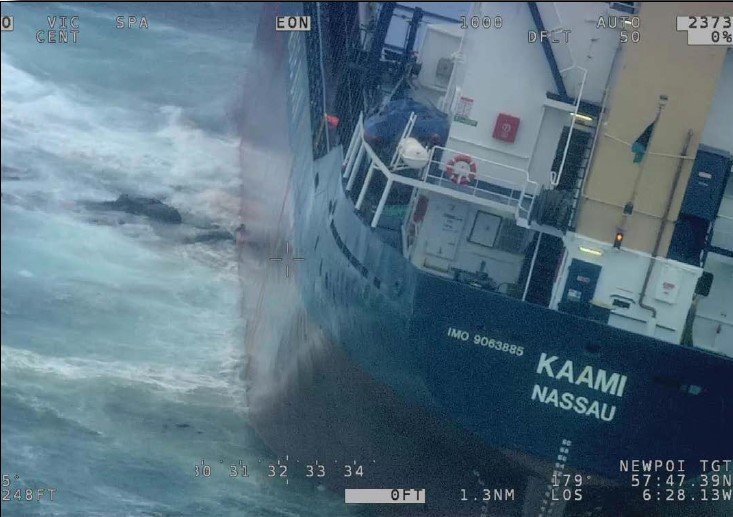
At 01:41 on 23 March 2020, the general cargo vessel Kaami grounded on Sgeir Graidach shoal in the Little Minch while on passage from Drogheda to Slite. The crew were evacuated safely and there were no injuries, but the hull damage was so severe that the ship was declared a constructive total loss. This incident shows how poor voyage planning and degraded bridge engagement can combine into a very expensive casualty.

The MAIB found that Kaami’s voyage plan had not been fully appraised, safety contour settings on the ECDIS were wrong, the ECDIS route safety check was not carried out, and the plan was created by one person without an effective second check. During the passage, look-ahead functions were not activated, an audible alarm was muted, and a mandatory alarm was disabled. The vessel then ran aground on Sgeir Graidach shoal and became a constructive total loss.
This casualty did not arise from one failure alone. Several protective layers were weak at the same time.
• The master relied on previous experience instead of conducting a full appraisal of the route and under-keel safety.
• The ECDIS route safety check and an effective second check of the plan did not take place.
• Look-ahead functions were not activated, an audible alarm was muted, and a mandatory alarm was disabled.
• Lookout effectiveness was reduced and the bridge team did not maintain a strong shared mental model of the route and risk picture.
In a case like Kaami, the primary fixes are better voyage planning, correct ECDIS setup, and active use of existing safeguards. The role of an additional vigilance layer is narrower: to help maintain active bridge engagement, reduce attention drift, and prompt earlier re-checks when monitoring becomes passive on a quiet bridge.
Presented this way, Aware Mate supports the human side of route monitoring without pretending to fix poor planning on its own.
Aware Mate is an on-board, human-in-the-loop vigilance layer designed to complement bridge watchkeeping and BNWAS. It estimates sustained drowsiness and distraction risk from non-identifying cues such as eyelid closure, gaze stability, head position, and posture, then issues graded local alerts. Where configured, it can use a BNWAS-compatible dry-contact path to escalate through existing shipboard alarm chains.
Aware Mate does not steer the vessel, take navigational decisions, identify people, diagnose medical conditions, perform emotion recognition, or send raw video ashore by default. Standard operation is on-board processing with configurable retention for derived metrics and event logs.
Modern bridge risk is not only sleep. It is also over-trust in screens, muted alarms, and weak plan discipline.
A planning and monitoring failure can still become a constructive total loss even without fatalities.
Kaami helps explain why the value proposition is broader than fatigue detection alone – it is active bridge vigilance.
Take-home message: Kaami is a reminder that technology still needs engaged humans. Aware Mate fits as an earlier vigilance layer inside that bigger safety system.
| Cookie | Duration | Description |
|---|---|---|
| cookielawinfo-checkbox-analytics | 11 months | This cookie is set by GDPR Cookie Consent plugin. The cookie is used to store the user consent for the cookies in the category "Analytics". |
| cookielawinfo-checkbox-functional | 11 months | The cookie is set by GDPR cookie consent to record the user consent for the cookies in the category "Functional". |
| cookielawinfo-checkbox-necessary | 11 months | This cookie is set by GDPR Cookie Consent plugin. The cookies is used to store the user consent for the cookies in the category "Necessary". |
| cookielawinfo-checkbox-others | 11 months | This cookie is set by GDPR Cookie Consent plugin. The cookie is used to store the user consent for the cookies in the category "Other. |
| cookielawinfo-checkbox-performance | 11 months | This cookie is set by GDPR Cookie Consent plugin. The cookie is used to store the user consent for the cookies in the category "Performance". |
| viewed_cookie_policy | 11 months | The cookie is set by the GDPR Cookie Consent plugin and is used to store whether or not user has consented to the use of cookies. It does not store any personal data. |
See how Aware Mate fits your bridge setup and discuss operational fit, privacy boundaries, and next steps.