
Incident Analysis
Based on the Bulgarian Ministry of Transport and Communications final report. This case shows how one lapse at a key waypoint can expand into salvage difficulty, cargo handling, and environmental exposure.
Important note: Aware Mate was not installed on Vera Su. This page uses the official investigation to show where an earlier on-board vigilance alert could have helped interrupt the incident chain. Any intervention sequence is illustrative, not proof of a live deployment.
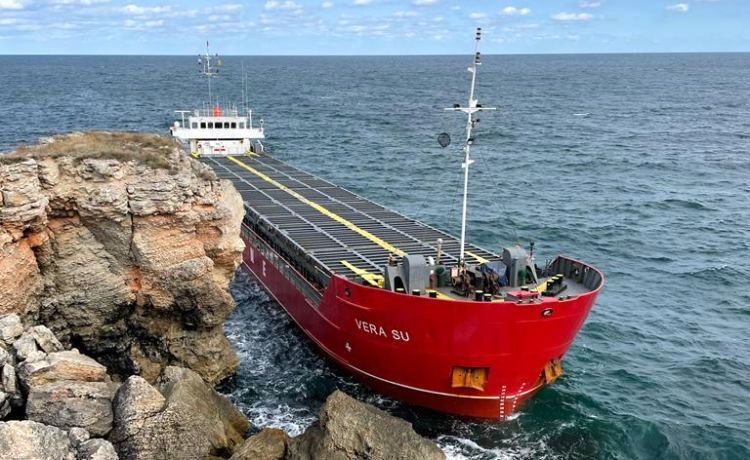
At 04:13 on 20 September 2021, the motor vessel Vera Su ran aground on the Bulgarian coast in the Yailata Protected Area while on passage from Yuzhniy to Varna. The crew was later evacuated, part of the cargo was discharged, and the casualty became both an environmental and reputational problem. This incident shows how a brief sleep-related lapse can grow well beyond the initial navigational error.

The official investigation found that Vera Su missed the waypoint for joining the traffic separation scheme because the second officer fell asleep. At the time of grounding, the bridge watch consisted only of the second officer, without a lookout. The vessel then ran aground on a steep and rocky stretch of coast, where access and refloating were difficult. Hull damage and the location of the casualty quickly increased the consequences of what began as a watchkeeping failure.
This casualty did not arise from one failure alone. Several protective layers were weak at the same time.
• A critical course decision depended on one officer remaining alert at exactly the right point in the passage.
• The bridge watch at the time of grounding consisted only of the second officer, without the lookout that should have reinforced the dark-hours watch.
• The BNWAS, which could have alerted the crew, was set with the alarm turned off.
• Once grounded, the protected-area location and prolonged refloating effort increased cargo-handling, environmental, and reputational exposure.
In a case like Vera Su, the role of an additional vigilance layer is not to replace proper watch composition or route-monitoring discipline. It is to provide an earlier cue that alertness has degraded before a missed waypoint becomes a grounding in a protected coastal area.
The value here is earlier warning and earlier recovery. The aim is not to claim that every protected-area casualty would be avoided, but to reduce the chance that one lapse expands into cargo handling, environmental exposure, and prolonged salvage.
Aware Mate is an on-board, human-in-the-loop vigilance layer designed to complement bridge watchkeeping and BNWAS. It estimates sustained drowsiness and distraction risk from non-identifying cues such as eyelid closure, gaze stability, head position, and posture, then issues graded local alerts. Where configured, it can use a BNWAS-compatible dry-contact path to escalate through existing shipboard alarm chains.
Aware Mate does not steer the vessel, take navigational decisions, identify people, diagnose medical conditions, perform emotion recognition, or send raw video ashore by default. Standard operation is on-board processing with configurable retention for derived metrics and event logs.
A short lapse at a key waypoint can create a much wider operational problem once a vessel grounds in a hard-to-access coastal area.
Protected-area groundings bring environmental exposure, salvage complexity, cargo handling cost, and reputational pressure into the same loss event.
This case makes the upstream value story easy to grasp: earlier interruption matters most before a short lapse becomes a long and costly casualty.
Take-home message: Vera Su shows why earlier vigilance signals matter most before a minor track error turns into a protected-area casualty.
| Cookie | Duration | Description |
|---|---|---|
| cookielawinfo-checkbox-analytics | 11 months | This cookie is set by GDPR Cookie Consent plugin. The cookie is used to store the user consent for the cookies in the category "Analytics". |
| cookielawinfo-checkbox-functional | 11 months | The cookie is set by GDPR cookie consent to record the user consent for the cookies in the category "Functional". |
| cookielawinfo-checkbox-necessary | 11 months | This cookie is set by GDPR Cookie Consent plugin. The cookies is used to store the user consent for the cookies in the category "Necessary". |
| cookielawinfo-checkbox-others | 11 months | This cookie is set by GDPR Cookie Consent plugin. The cookie is used to store the user consent for the cookies in the category "Other. |
| cookielawinfo-checkbox-performance | 11 months | This cookie is set by GDPR Cookie Consent plugin. The cookie is used to store the user consent for the cookies in the category "Performance". |
| viewed_cookie_policy | 11 months | The cookie is set by the GDPR Cookie Consent plugin and is used to store whether or not user has consented to the use of cookies. It does not store any personal data. |
See how Aware Mate fits your bridge setup and discuss operational fit, privacy boundaries, and next steps.