
Incident Analysis
Based on the MAIB investigation. This is a high-value case for operators and insurers because it combines chronic workload, disabled safeguards, salvage complexity, and grounding inside an environmentally sensitive area.
Important note: Aware Mate was not installed on Danio. This page uses the official investigation to show where an earlier on-board vigilance alert could have helped interrupt the incident chain. Any intervention sequence is illustrative, not proof of a live deployment.
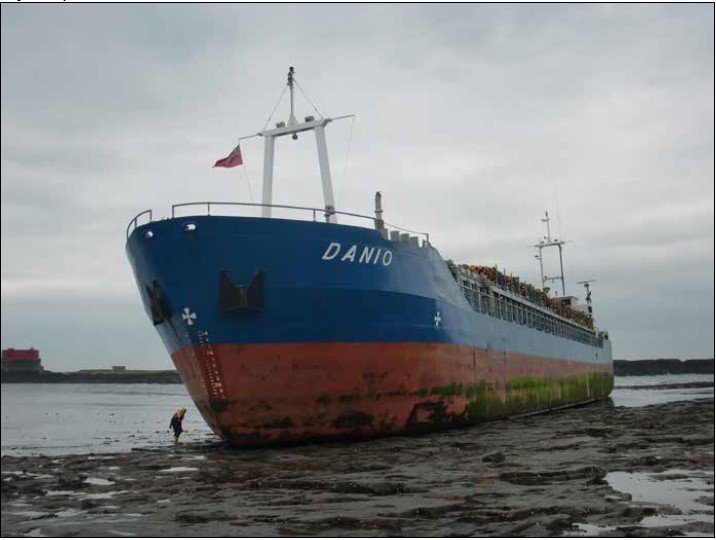
At 03:30 on 16 March 2013, the general cargo vessel Danio grounded in the Farne Islands nature reserve while on passage from Perth to Genk. The vessel remained aground for 12 days before being refloated. There was no pollution, but the ship suffered serious damage to forward compartments, the rudder, and the propeller.

The chief officer, who was the officer of the watch, had fallen asleep. MAIB found that the very high workload placed on the two deck officers was typical of many near-coastal cargo ships: cargo supervision in port, then a six-on/six-off watchkeeping routine at sea. The accident showed how cumulative fatigue can remain hidden until it becomes a grounding.
This casualty did not arise from one failure alone. Several protective layers were weak at the same time.
• Danio had a fully functional BNWAS, but it was permanently switched off.
• No lookout was posted on the bridge, despite the international requirement to use one.
• Watchkeepers relied on an unapproved electronic navigation system even though paper charts were the designated primary means.
• Internal audits had not identified that actual onboard practice was diverging from documented procedures.
• The grounding occurred in a sensitive environmental area, increasing the consequences even though pollution was avoided.
In a case like Danio, Aware Mate should be framed as an earlier fatigue and inattention alerting layer, especially where operators know that two-watch systems and port workload already compress effective rest.
The product message should stay practical: earlier warning, on board, inside a broader fatigue-risk and bridge-assurance framework.
Aware Mate is an on-board, human-in-the-loop vigilance layer designed to complement bridge watchkeeping and BNWAS. It estimates sustained drowsiness and distraction risk from non-identifying cues such as eyelid closure, gaze stability, head position, and posture, then issues graded local alerts. Where configured, it can use a BNWAS-compatible dry-contact path to escalate through existing shipboard alarm chains.
Aware Mate does not steer the vessel, take navigational decisions, identify people, diagnose medical conditions, perform emotion recognition, or send raw video ashore by default. Standard operation is on-board processing with configurable retention for derived metrics and event logs.
This is the commercial reality of under-supported coastal trading: chronic workload turns into operational and regulatory risk.
Protected-area groundings bring salvage cost, environmental scrutiny, and disproportionate claims attention.
Danio shows why early alertness support matters even when hours-of-rest paperwork appears compliant.
Take-home message: Danio is a strong case for earlier alertness support, but it also underlines that fatigue risk is organisational, not just individual.
| Cookie | Duration | Description |
|---|---|---|
| cookielawinfo-checkbox-analytics | 11 months | This cookie is set by GDPR Cookie Consent plugin. The cookie is used to store the user consent for the cookies in the category "Analytics". |
| cookielawinfo-checkbox-functional | 11 months | The cookie is set by GDPR cookie consent to record the user consent for the cookies in the category "Functional". |
| cookielawinfo-checkbox-necessary | 11 months | This cookie is set by GDPR Cookie Consent plugin. The cookies is used to store the user consent for the cookies in the category "Necessary". |
| cookielawinfo-checkbox-others | 11 months | This cookie is set by GDPR Cookie Consent plugin. The cookie is used to store the user consent for the cookies in the category "Other. |
| cookielawinfo-checkbox-performance | 11 months | This cookie is set by GDPR Cookie Consent plugin. The cookie is used to store the user consent for the cookies in the category "Performance". |
| viewed_cookie_policy | 11 months | The cookie is set by the GDPR Cookie Consent plugin and is used to store whether or not user has consented to the use of cookies. It does not store any personal data. |
See how Aware Mate fits your bridge setup and discuss operational fit, privacy boundaries, and next steps.